 Emma Thornton
Why Probiotics Are Used for Gut Health
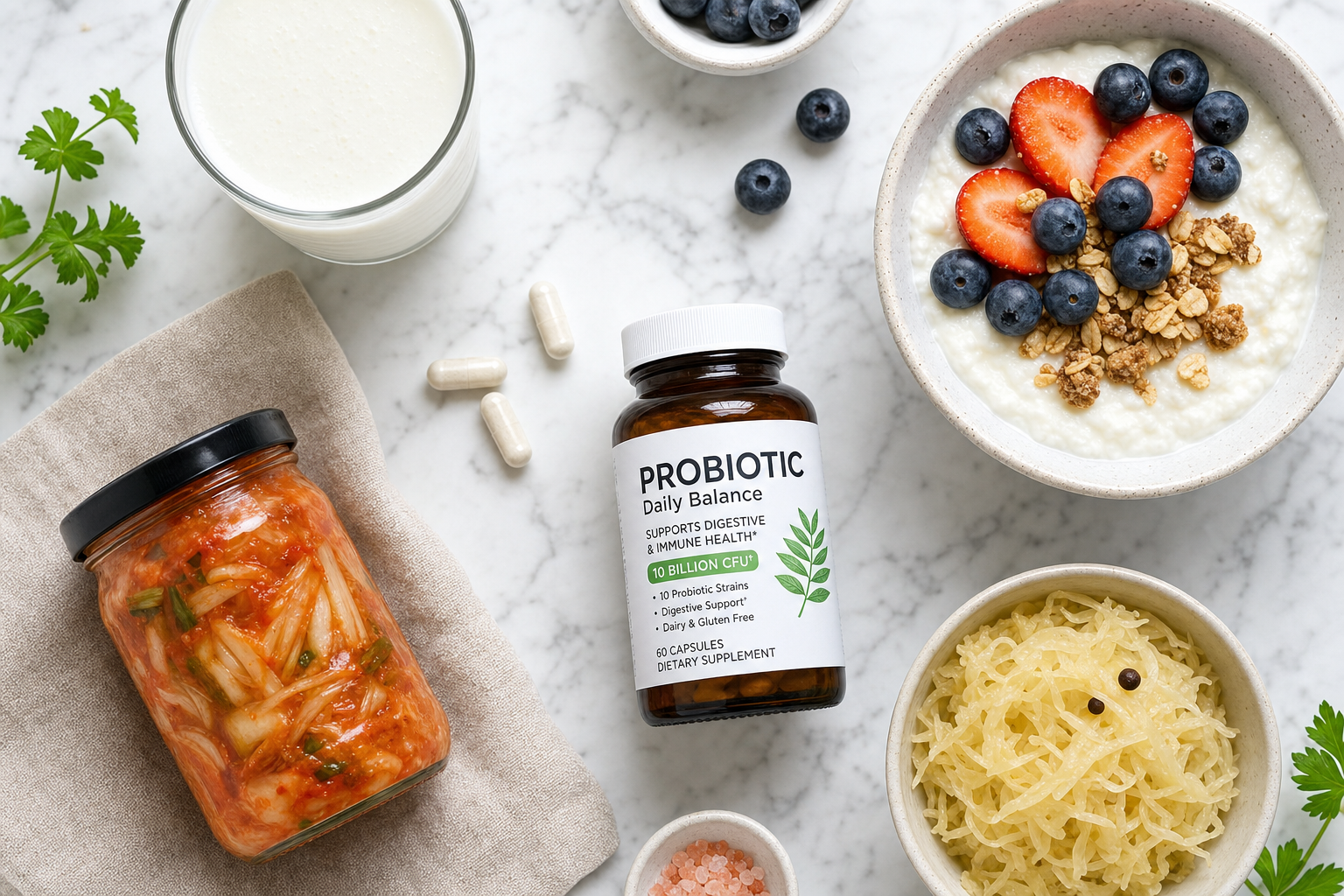
Probiotics are live microorganisms that, when consumed in adequate amounts, confer a health benefit on the host. They are found naturally in fermented foods — yogurt, kefir, kimchi, sauerkraut, miso, and kombucha — and are available as dietary supplements in capsule, powder, and liquid form. Interest in probiotics has grown enormously alongside research into the gut microbiome — the trillion-strong community of bacteria that colonise the large intestine and influence immunity, metabolism, mood, and digestion. Probiotics offer a way to introduce or reinforce specific beneficial bacterial strains. For a full supplement context, see our complete supplement guide. For an understanding of how fiber supports the microbiome alongside probiotics, see our gut microbiome and fiber guide.
What Probiotics Are
Not all probiotics are the same — strain specificity matters enormously. A probiotic’s effects are determined by genus, species, and strain. Lactobacillus rhamnosus GG (LGG) has robust evidence for preventing antibiotic-associated diarrhoea; Bifidobacterium infantis 35624 is well-studied for IBS; Saccharomyces boulardii (technically a yeast) has the strongest evidence for treating various forms of diarrhoea. A probiotic that is effective for one condition may have no effect for another — making strain selection critical and general “probiotic” marketing without strain specification largely meaningless.
Probiotic Benefits
The best-evidenced probiotic benefits include: prevention and treatment of antibiotic-associated diarrhoea (strongest evidence — LGG and S. boulardii are recommended by multiple clinical guidelines); treatment of infectious diarrhoea (modest reduction in duration); IBS symptom relief (specific strains reduce bloating, abdominal pain, and altered bowel habits in IBS); vaginal health (Lactobacillus strains support healthy vaginal microbiome and reduce recurrent bacterial vaginosis); immune modulation (specific strains reduce the incidence and duration of upper respiratory tract infections in children and adults).
Probiotics and Digestive Health
Lactobacillus and Bifidobacterium
These two genera contain the most extensively studied probiotic species. Lactobacillus strains are acid-tolerant, thrive in the small intestine, and produce lactic acid that creates an antimicrobial environment. Bifidobacterium strains dominate the large intestine, ferment fiber, produce beneficial short-chain fatty acids, and have particularly strong evidence for immune modulation. Most commercial probiotic supplements contain multiple strains from both genera.
CFU Count and Shelf Stability
CFU (Colony Forming Units) is the measure of viable bacteria in a probiotic supplement. Most clinical trials use doses of 1–10 billion CFU. Higher CFU counts are not necessarily better — strain appropriateness matters more than raw numbers. Probiotics must be viable when consumed to be effective — temperature stability during shipping and storage is a significant quality concern. Look for products with CFU counts guaranteed at expiry (not just at manufacture), and store as directed (some require refrigeration; others are shelf-stable).
Probiotics for Bloating and Diarrhoea
For bloating and IBS, Bifidobacterium infantis 35624 and Lactobacillus plantarum 299v have the strongest evidence. For diarrhoea (antibiotic-associated or infectious), LGG and S. boulardii are the evidence-backed choices. For general gut health maintenance without a specific condition, a multi-strain formula including Lactobacillus acidophilus, Bifidobacterium lactis, and Lactobacillus rhamnosus is a reasonable starting point.
Probiotics and Antibiotics
Taking probiotics during and after a course of antibiotics is one of the most evidence-supported probiotic uses. Antibiotics disrupt the gut microbiome non-selectively, eliminating beneficial bacteria alongside harmful ones and creating space for opportunistic organisms (like C. difficile). LGG or S. boulardii taken 2 hours apart from antibiotic doses and continued for 1–2 weeks after the course completes meaningfully reduces antibiotic-associated diarrhoea risk.
Food Sources vs Supplements
Fermented foods provide probiotics alongside prebiotic fiber, polyphenols, and other beneficial compounds absent from supplements. Kefir (a fermented dairy drink) is one of the richest food sources of diverse live bacteria. Yogurt with live cultures, kimchi, sauerkraut, and miso all provide meaningful probiotic benefit. For healthy people without a specific condition, building fermented foods into the diet is the most holistic approach. Supplements are most valuable for specific therapeutic purposes (antibiotic recovery, IBS, specific infections) where a particular strain at a defined dose is needed.
Side Effects and Safety
Probiotics are generally very safe for healthy adults. Initial supplementation can cause temporary bloating and increased gas as the gut microbiome adjusts — this typically resolves within 1–2 weeks. Probiotics should be avoided or used only under medical supervision in severely immunocompromised individuals, those with central venous catheters, and premature infants — rare cases of septicaemia from probiotic organisms have been reported in these vulnerable populations.
FAQ
What do probiotics do?
Support gut microbiome health, prevent and treat diarrhoea, reduce IBS symptoms, support immune function, and maintain healthy vaginal flora — with effects highly dependent on specific strains used.
Which probiotic strain is best?
Depends on the goal: LGG for antibiotic-associated diarrhoea; S. boulardii for infectious diarrhoea; B. infantis 35624 for IBS; Lactobacillus strains for vaginal health.
How many CFUs do I need?
1–10 billion CFU is the range used in most clinical trials. More is not necessarily better. Strain appropriateness and product quality matter more than CFU count.
Can probiotics cause side effects?
Temporary bloating and gas are common when starting supplementation. Serious side effects are rare in healthy adults. Caution is warranted in immunocompromised individuals.
Should I take probiotics with antibiotics?
Yes — taking LGG or S. boulardii 2 hours apart from antibiotic doses during and after a course meaningfully reduces antibiotic-associated diarrhoea risk.
synbiotics“>Probiotics vs Prebiotics vs Synbiotics: What Is the Difference?
| Term | What It Is | Examples |
|---|---|---|
| Probiotics | Live beneficial microorganisms | Lactobacillus, Bifidobacterium, Saccharomyces boulardii |
| Prebiotics | Non-digestible fibers that feed gut bacteria | Inulin, FOS, GOS, psyllium husk, glucomannan |
| Synbiotics | Probiotics + prebiotics combined | Supplement with Lactobacillus strains + inulin fiber |
What is the difference between probiotics prebiotics and synbiotics?
Probiotics are live bacteria you consume. Prebiotics are fibers that feed those bacteria. Synbiotics combine both. Probiotics are the seeds, prebiotics are the fertiliser, synbiotics deliver both together.
Should I take a probiotic or prebiotic supplement?
For general gut health, prebiotics from whole foods (oats, garlic, onions, leeks) are often more impactful than probiotic supplements because they feed your existing diverse microbial community. Probiotic supplements are most useful for specific conditions — IBS, antibiotic recovery, traveller’s diarrhoea — where a particular strain has evidence for your goal.
Are synbiotics better than probiotics alone?
Early evidence suggests synbiotics may offer advantages because the prebiotic component helps probiotic bacteria survive gut transit and establish in the colon. The quality of specific strains and fibers matters more than whether something is labelled a synbiotic.
Related reading: Probiotics for Women, Best Probiotic Strains, Do Probiotics Make You Poop?, Synbiotics vs Probiotics.


 Elena Voss

 James Hargreaves
 James Holloway
 Daniel Brooks