 Sarah Mitchell
Creatine has been studied more extensively than almost any other supplement. There are hundreds of randomised controlled trials, multiple systematic reviews, and decades of safety data across populations ranging from elite athletes to elderly adults to people with neurological conditions. At this point, arguing about whether creatine works for strength and performance is a bit like arguing about whether exercise is good for you — the evidence is overwhelming.
What’s more interesting in 2025 is the growing body of research on creatine’s effects beyond the gym — on brain function, healthy aging, and women specifically, who have historically been underrepresented in creatine research. Some of that evidence is convincing. Some is promising but not yet definitive. Here’s the honest breakdown.
How Creatine Works
Creatine is stored in muscle (and to a lesser extent in the brain) as phosphocreatine. During short, intense bursts of effort — sprinting, heavy lifting, explosive movements — the body needs ATP faster than aerobic metabolism can supply it. Phosphocreatine donates a phosphate group to replenish ATP almost instantly, extending how long maximal effort can be sustained before fatigue kicks in.
The result: more reps before failure, more power in explosive movements, faster recovery between sets. Over time, this translates to greater training adaptations — more strength, more muscle, better performance. It’s not a shortcut to fitness. It’s a tool that makes your training more productive.
About 95% of the body’s creatine is stored in skeletal muscle. Vegetarians and vegans have lower baseline muscle creatine stores (because dietary creatine comes almost exclusively from meat and fish), which means they typically see larger gains from supplementation than meat-eaters.
Strength and Muscle: The Definitive Evidence
This is settled science. Meta-analyses consistently find that creatine supplementation combined with resistance training produces greater increases in strength and lean mass than training alone. Effect sizes are meaningful — not enormous, but real and well-replicated across hundreds of trials.
A 2025 systematic review in Frontiers in Nutrition confirmed these findings across multiple populations and training types. A separate 2025 UNSW trial found no additional muscle gain benefit from 5g/day creatine in a specific 12-week resistance program — a reminder that individual trials can conflict with the broader meta-analytic picture. Overall, the weight of evidence for strength and muscle adaptation is unambiguous.
The mechanism goes beyond just more reps. Creatine also appears to influence satellite cell activity, glycogen replenishment, and protein synthesis signalling — effects that may contribute to muscle adaptation independently of simply enabling more training volume.
Brain Function and Cognition: Promising But Not Proven
The brain uses creatine for energy too — neurons depend on rapid ATP turnover, and phosphocreatine plays the same buffering role in brain tissue as in muscle. This has generated substantial interest in creatine for cognitive function, particularly in situations where brain energy demand is high or ATP supply is compromised.
The evidence is most consistent in two scenarios: cognitive tasks under sleep deprivation, and older adults. Several studies find that creatine supplementation reduces cognitive impairment after sleep deprivation — an effect that makes mechanistic sense given brain energy demands. Some studies in older adults show improvements in memory and executive function. The general population cognitive effects in young, well-rested adults are less consistent.
A 2025 review characterised the cognitive evidence as “emerging and promising but not yet robust.” This is accurate. It’s biologically plausible, the preliminary data is interesting, and the safety profile makes it low-risk to try if this is a goal — but don’t take creatine expecting it to noticeably sharpen your thinking on a normal day.
Healthy Aging: A Reasonable Adjunct
Sarcopenia — age-related muscle loss — is one of the most significant drivers of functional decline and mortality risk in older adults. Creatine combined with resistance training has shown benefits for muscle preservation and strength in older populations in multiple trials, and 2025 reviews characterise it as a reasonable adjunct to resistance training for aging-related muscle preservation.
The practical picture: if you’re an older adult doing resistance training (which you should be), adding creatine is low-risk and potentially meaningful for maintaining the muscle mass that keeps you functional, independent, and metabolically healthy. It’s not a substitute for training — it enhances the return on the training you do. See our guide to muscle loss and sarcopenia for more on this.
Creatine for Women: An Underexplored Area
The vast majority of early creatine research used male subjects. This is changing. 2025 reviews on creatine in women find real benefits for physical performance and lean mass, with some evidence for cognitive benefits as well — particularly in vegetarian women and older women who have lower baseline creatine stores. The effect sizes appear similar to those in men.
One area of particular interest is creatine during perimenopause and menopause. Declining oestrogen is associated with reductions in muscle creatine stores, and preliminary evidence suggests creatine may help offset some of this. This is a developing area — watch for more research over the next few years.
The bottom line for women: creatine works, the evidence is increasingly strong, and the old assumption that it’s “for men who want to bulk up” is simply wrong.
Does Creatine Cause Hair Loss?
This is probably the most common concern people raise. It stems from a single 2009 study in rugby players that found increased DHT (dihydrotestosterone) levels with creatine supplementation — DHT being associated with male pattern hair loss. That study has never been replicated, the DHT increase was within normal physiological range, and no subsequent research has found a link between creatine and hair loss. The concern is not supported by current evidence. See our dedicated article on creatine and hair loss for the full breakdown.
How to Take It
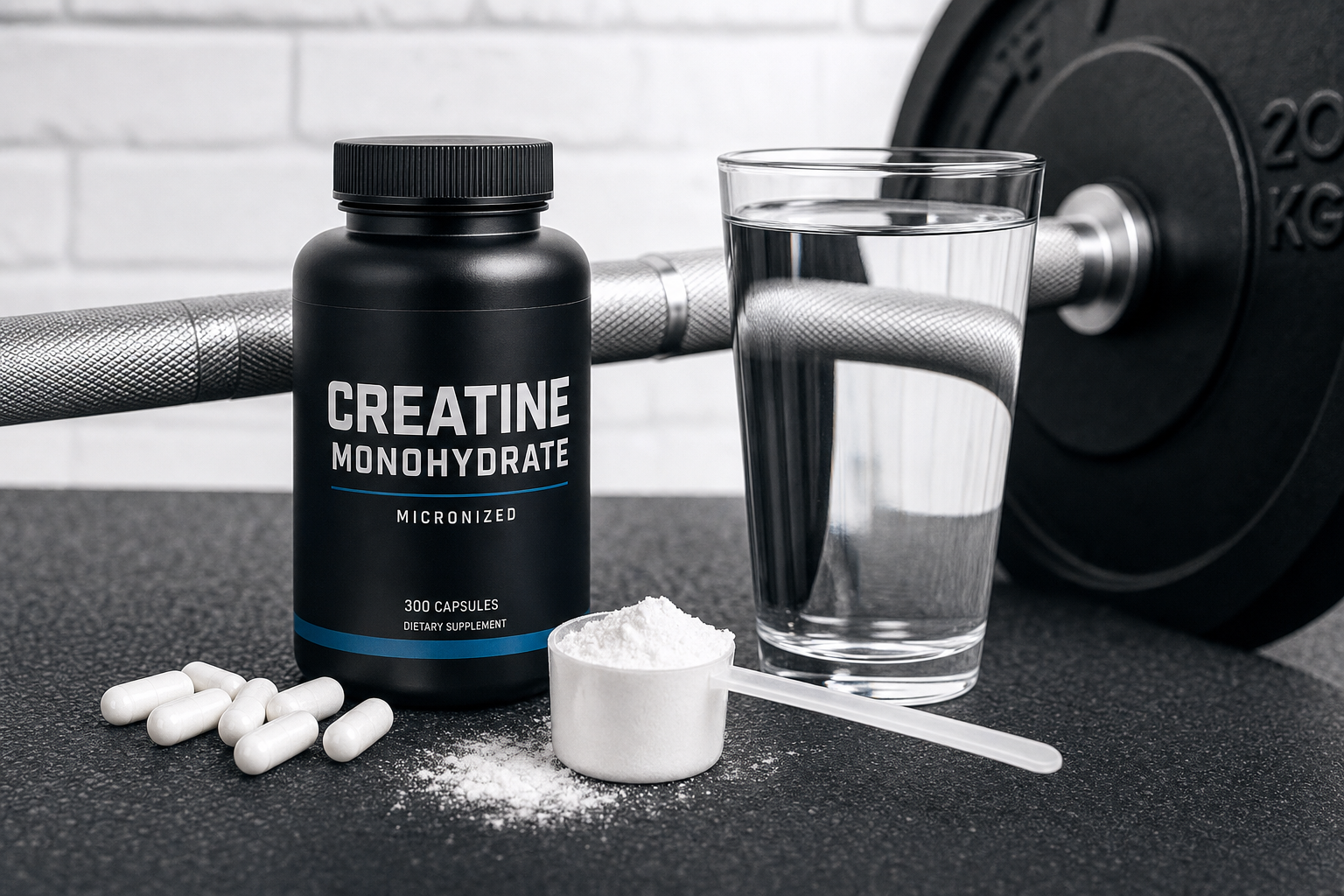
Form: Creatine monohydrate is the best-studied form and works as well as any other. More expensive forms — creatine HCl, kre-alkalyn, buffered creatine — have no demonstrated superiority. Buy the cheap generic monohydrate.
Dose: 3–5g daily is the standard maintenance dose and is what most research uses. Loading (20g/day for 5–7 days) saturates muscle stores faster but produces the same long-term result as simply taking 3–5g/day — it just takes 3–4 weeks to reach saturation at the lower dose.
Timing: Timing matters less than consistency. Post-workout with a meal is marginally supported by some research, but the difference is small. Take it at whatever time you’ll remember to take it every day.
Water: Creatine draws water into muscle cells. Staying well-hydrated matters more when supplementing — aim for at least 2–3 litres daily.
Cycling: There’s no evidence that cycling on and off creatine is necessary. Daily consistent use is fine indefinitely.
Safety
Creatine is one of the most extensively studied and consistently safe supplements available. The concerns about kidney damage that circulated for years have not been supported by research in healthy individuals. Long-term use at recommended doses has not been associated with adverse effects on kidney function, liver function, or any other organ system. People with pre-existing kidney disease should check with their doctor, as a matter of general caution with any supplement that influences kidney filtration markers.
Frequently Asked Questions
What does creatine actually do?
It increases phosphocreatine stores in muscle, enabling faster ATP regeneration during high-intensity effort. This means more reps before failure, more power, and faster recovery between sets — which translates to greater strength and muscle adaptations over time.
Should I take creatine if I don’t exercise?
The strength and muscle benefits require exercise to manifest. Brain-related benefits may occur independently of exercise, but the evidence is weaker. For most people, creatine is most valuable when combined with resistance training.
Does creatine make you gain weight?
Yes — initially, through water retention in muscle cells (typically 1–2kg). This is not fat gain. Over time, additional weight gain reflects genuine muscle mass increase from improved training adaptation.
Is creatine safe for women?
Yes — the safety profile is the same as for men. The concern that creatine is “for men” or will cause unwanted bulk is not supported by evidence. Women gain strength and lean mass benefits without looking “bulky,” in the same way that resistance training for women produces tone rather than bulk.
Do I need to load creatine?
No. Loading (20g/day for 5–7 days) saturates muscle stores faster, but 3–5g/day reaches the same saturation over 3–4 weeks. Both approaches produce equivalent long-term results.
The Bottom Line
Creatine monohydrate is the best-evidenced performance supplement available, full stop. The strength and muscle evidence is definitive. The brain and aging evidence is promising and growing. The safety profile is excellent across decades of research. It’s inexpensive, widely available, and works regardless of sex or age. If you do resistance training and you’re not taking creatine, you’re leaving a genuine, low-risk performance benefit on the table.
Related: Home Workout Plan | Best Supplements for Overall Health | How to Boost Metabolism

 James Hargreaves
 Elena Voss
 Sarah Mitchell
 Dr. Maya Chen
 Dr. Rachel Stone
 James Holloway