 Elena Voss
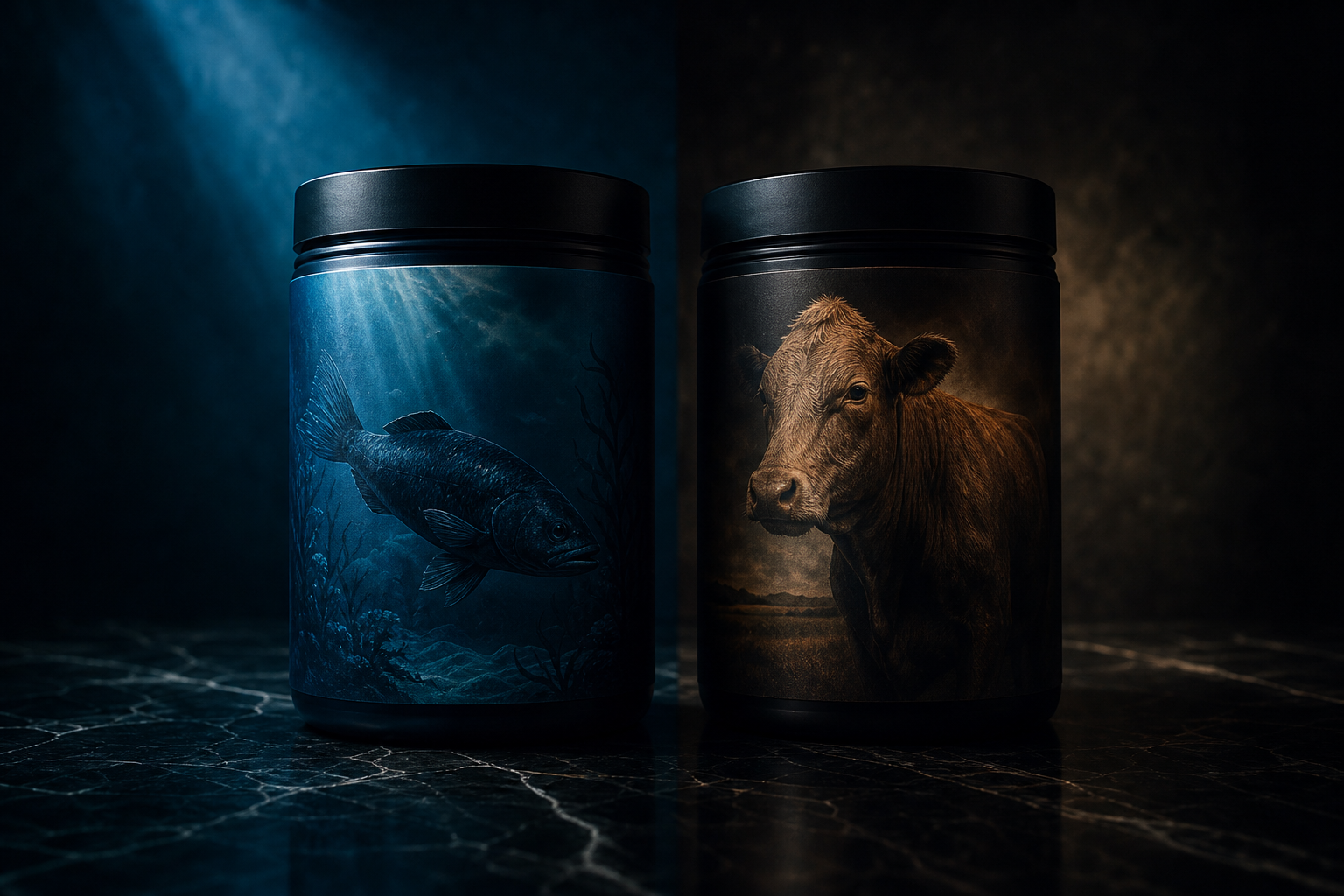
Marine collagen and bovine collagen are both popular supplements, but they come from different sources, contain different collagen types, and have somewhat different applications. Here’s a clear breakdown to help you choose.
What’s the Difference?
| Feature | Marine Collagen | Bovine Collagen |
|---|---|---|
| Source | Fish skin, scales, bones | Cow hides, bones, tendons |
| Collagen types | Primarily Type I | Types I and III |
| Peptide size | Smaller (~300–500 Da) | Larger (~1,000–2,000 Da) |
| Absorption rate | Faster, higher bioavailability | Good, but slightly slower |
| Best for | Skin, hair, nails | Gut, joints, muscle, bone |
| Sustainability | Varies — look for MSC certified | Varies — look for grass-fed |
| Allergen risk | Fish allergy risk | Suitable for fish-allergic |
| Taste/smell | Mild, slightly fishy | Virtually unflavoured |
Marine Collagen: Strengths and Evidence
Marine collagen is primarily Type I — the same type that makes up approximately 90% of the skin’s collagen content. Its smaller peptide size (due to the fish source’s unique amino acid structure) means it’s absorbed more rapidly and efficiently than bovine collagen, and distributes more readily to the skin.
The skin evidence for marine collagen is strong: a 2021 systematic review of 11 RCTs found significant improvements in skin elasticity, hydration, and wrinkle reduction with marine collagen supplementation. Studies specifically comparing marine to bovine for skin outcomes generally find marine collagen produces faster and more pronounced skin improvements.
Marine collagen also typically contains higher hydroxyproline content — an amino acid that is the precursor to the hydroxyproline-proline-glycine tripeptide sequence that directly stimulates fibroblasts (collagen-producing cells) in the skin.
Bovine Collagen: Strengths and Evidence
Bovine collagen contains both Type I and Type III — Type III is found in muscles, blood vessels, organs, and young skin, and declines with age alongside Type I. The Type I + III combination makes bovine collagen particularly useful for gut health (collagen strengthens the gut lining), muscle recovery, joint support (particularly in combination with Type II), and bone density.
For gut health specifically, bovine collagen’s glycine content is particularly beneficial — glycine supports the tight junction proteins that maintain gut barrier integrity. Many people with leaky gut or IBS use bovine collagen (or bone broth, which is rich in it) specifically for this purpose.
The bone density research (particularly the landmark 2018 RCT of post-menopausal women) used bovine-derived specific collagen peptides. For joint and bone applications, bovine has the most direct evidence.
Which Should You Choose?
- Skin, hair, nails → Marine collagen (Type I, faster absorption, better skin distribution)
- Gut health, joints, muscle → Bovine collagen (Types I + III, glycine-rich)
- Bone density → Bovine (most direct evidence from RCTs)
- General health, aging → Either or both (complementary profiles)
- Fish allergy → Bovine only
- Pescatarian → Marine collagen is suitable
For those wanting comprehensive coverage, some products combine marine and bovine collagen peptides. Alternatively, taking marine collagen in the morning (skin focus) and bovine collagen in the evening (gut/recovery focus) is a practical protocol used by many practitioners.
Frequently Asked Questions
For skin specifically, yes — marine collagen’s smaller peptide size, higher bioavailability, and Type I focus makes it superior for skin outcomes. For gut health, joints, bone density, and muscle support, bovine collagen (Types I + III) has the better evidence base. Neither is universally “better” — it depends on your goals.
Yes — they’re complementary rather than competitive. Marine collagen covers Type I with high absorption for skin; bovine adds Type III for gut and vascular health. Combined collagen products exist, or you can use them at different times of day. No adverse interactions have been documented.
For skin anti-aging (reducing wrinkles, improving elasticity), marine collagen has the strongest evidence and faster results. For comprehensive anti-aging including bone density, muscle preservation, and joint health, a combination of marine (Type I) and bovine (Types I + III) with vitamin C addresses multiple ageing pathways simultaneously.
It depends on the source. Marine collagen made from fish processing waste (skins and scales that would otherwise be discarded) is more sustainable than fishing specifically for collagen. Look for products from MSC-certified fisheries. Wild-caught fish collagen is generally preferred over farmed for both sustainability and purity reasons.
This article is for informational purposes only. Those with fish or shellfish allergies should use bovine collagen only.

 Sarah Mitchell
 Dr. Rachel Stone
 James Hargreaves

 Rachel Summers