 Emma Thornton
Introduction to Sleep Architecture
Sleep is not a uniform state of unconsciousness. It is a highly structured biological process that cycles through distinct stages, each serving different physiological and neurological functions. Understanding these stages reveals why both total sleep duration and sleep quality matter — and why disrupting certain stages has specific, predictable consequences for recovery, memory, and health. For a broader overview of sleep and recovery, see our complete sleep and recovery guide.
The Main Sleep Stages
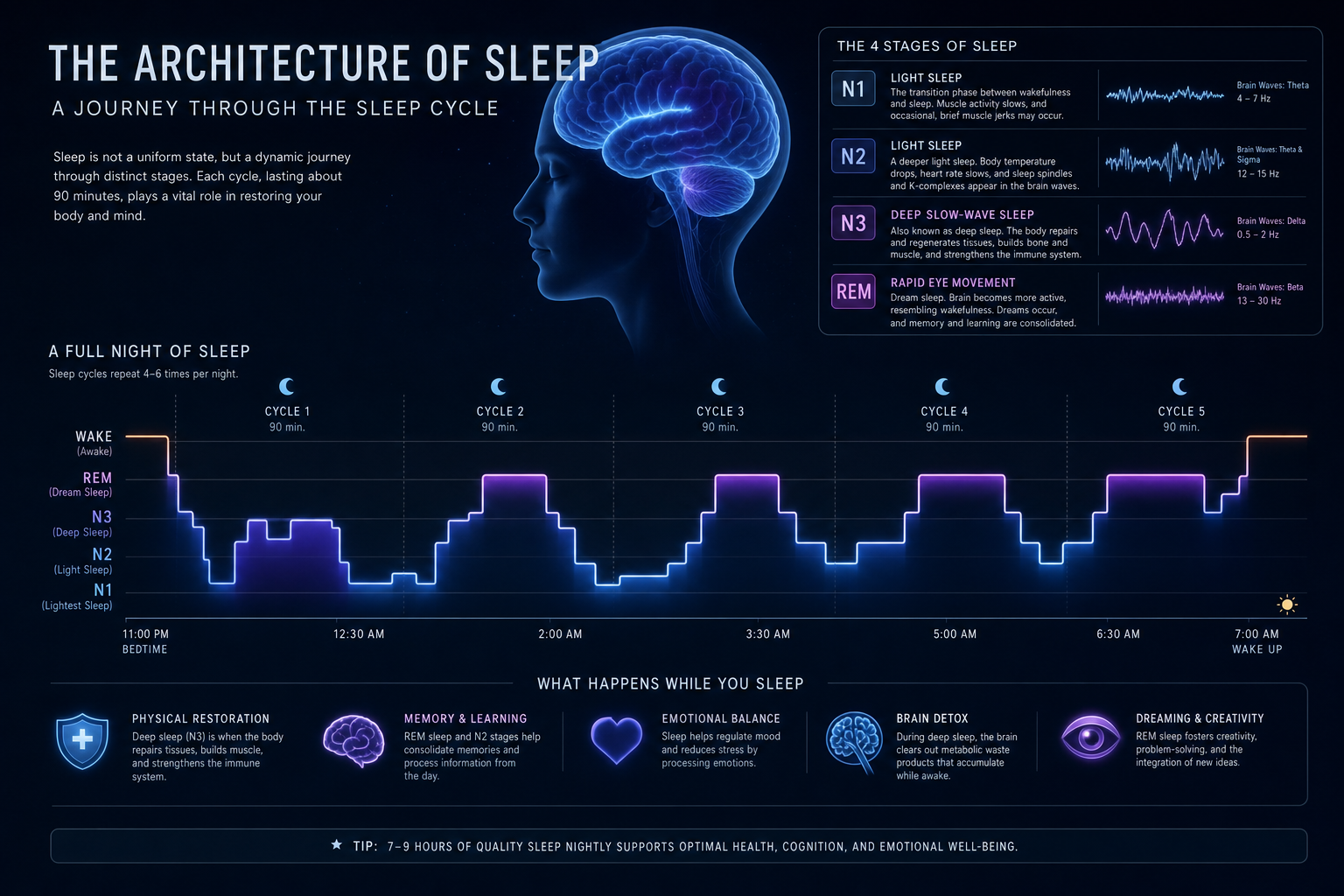
Sleep is divided into two major categories: non-REM (NREM) sleep and REM (Rapid Eye Movement) sleep. NREM sleep consists of three progressively deeper stages (N1, N2, N3), followed by REM sleep — and this sequence forms a single sleep cycle.
N1 — Light Sleep
N1 is the transition stage between waking and sleep — the lightest stage, lasting only 1–7 minutes. Muscle activity decreases, the eyes move slowly, and you can be easily awakened. This is the stage during which hypnic jerks (the sudden sensation of falling) commonly occur. N1 makes up only about 5% of total sleep time in a healthy sleeper.
N2 — Baseline Sleep
N2 is considered the baseline of sleep — a deeper state where heart rate slows, body temperature drops, and eye movement stops. Sleep spindles (bursts of neural activity) and K-complexes (large slow waves) appear on EEG during N2. These features are thought to be involved in memory consolidation and protecting sleep from external disturbance. N2 constitutes about 45–55% of total sleep time and is the stage most people are in when they wake from a night’s sleep.
N3 — Deep Sleep (Slow-Wave Sleep)
N3 is the deepest and most physically restorative stage of sleep. Also called slow-wave sleep (SWS) or delta sleep — named for the large, slow delta brain waves dominant during this stage — N3 is when the body does the majority of its physical repair work. Growth hormone is primarily released during N3, driving muscle recovery, tissue repair, and immune function. Blood pressure drops, breathing slows, and the body is hardest to wake during this stage. N3 constitutes 15–25% of sleep time, concentrated in the first half of the night. See our guide to sleep and muscle recovery for how N3 sleep supports physical performance.
REM Sleep
REM sleep is characterised by rapid eye movements, near-complete muscle paralysis (atonia), vivid dreaming, and brain activity patterns that closely resemble waking. REM sleep is the stage most critical for cognitive recovery — it supports emotional processing, memory consolidation, creative problem-solving, and learning consolidation. REM periods lengthen through the night, with the longest and most vivid REM phases occurring in the final hours of sleep (roughly hours 6–8). This explains why cutting sleep short by an hour or two disproportionately reduces REM sleep — a significant cognitive and emotional cost. REM constitutes 20–25% of total sleep time.
How Sleep Cycles Work
Cycle Length
A single sleep cycle — from N1 through N2, N3, and REM — lasts approximately 90 minutes, though this varies between 70 and 120 minutes across individuals and across the night. Understanding cycle length is useful for optimising wake timing: waking at the end of a cycle (rather than during deep sleep) results in feeling significantly more alert and refreshed.
Why Cycles Repeat
The body completes 4–6 full cycles per night in 7–9 hours of sleep. The composition of cycles shifts through the night: early cycles are dominated by N3 deep sleep (physical recovery), while later cycles contain more REM sleep (cognitive recovery). This explains why both the first and last hours of sleep serve distinct and important functions — and why sleeping a consistent 7–9 hours is superior to variable duration that may cut short either deep sleep or REM.
Why Each Stage Matters
Physical Recovery
N3 deep sleep is when the majority of growth hormone is released, muscle protein synthesis occurs, and immune cells are produced. Reducing deep sleep through alcohol, inconsistent timing, stress, or poor sleep environment directly impairs physical recovery and immune function. See our guide to improving sleep quality for strategies to increase time in N3.
Memory and Learning
Both N2 (through sleep spindles) and REM sleep play critical roles in memory consolidation. Declarative memories (facts and events) are processed primarily during NREM sleep, while procedural memories (motor skills and habits) are strongly consolidated during REM sleep. Students who sleep after learning retain information significantly better than those who remain awake — a finding replicated across dozens of studies.
Emotional Regulation
REM sleep is particularly important for emotional memory processing. During REM, the emotional intensity of memories is stripped from their content — a process sometimes called “overnight therapy.” Insufficient REM sleep leaves emotional memories fully charged, contributing to increased anxiety, reactivity, and difficulty processing difficult experiences. See our guide to sleep and mental health for this connection in detail.
What Disrupts Sleep Stages
Alcohol
Alcohol is one of the most significant disruptors of sleep architecture. While it accelerates sleep onset (hence its reputation as a “sleep aid”), it dramatically suppresses REM sleep in the first half of the night and causes rebound wakefulness and increased light sleep in the second half. Even moderate alcohol (2 units) reduces REM sleep by 20–25%. See our guide to sleep hygiene for how lifestyle choices affect sleep staging.
Stress
Elevated cortisol from psychological stress preferentially suppresses N3 deep sleep while increasing light sleep and waking. It also fragments REM sleep, impairing the emotional processing that REM provides — creating a vicious cycle where stress worsens sleep, and poor sleep increases stress reactivity.
Sleep Disorders
Sleep apnoea — repeated episodes of airway obstruction during sleep — repeatedly fragments sleep architecture, preventing the body from completing full cycles. Restless leg syndrome, periodic limb movement disorder, and narcolepsy all disrupt normal staging in different ways. If you experience persistent fatigue despite adequate hours in bed, a sleep study may reveal a disorder preventing you from reaching restorative stages. See our guide to insomnia causes and solutions for when to seek professional help.
FAQ
What is deep sleep?
Deep sleep (N3 or slow-wave sleep) is the most physically restorative sleep stage, characterised by large, slow delta brain waves. This is when growth hormone is released, muscles repair, and the immune system is most active. It makes up 15–25% of total sleep time.
How much REM sleep do you need?
Adults need approximately 90–120 minutes of REM sleep per night (20–25% of total sleep). Because REM is concentrated in the second half of the night, getting fewer than 7 hours significantly cuts into REM sleep time.
How many sleep cycles do you get per night?
Most adults complete 4–6 full sleep cycles per night in 7–9 hours, with each cycle lasting approximately 90 minutes.
Can you increase deep sleep?
Yes — consistent sleep timing, regular exercise (particularly aerobic exercise), avoiding alcohol, keeping your bedroom cool, and reducing evening stress all increase the proportion of time spent in N3 deep sleep.
What does REM sleep feel like?
REM sleep is when the most vivid dreaming occurs. The brain is highly active, the eyes move rapidly beneath the eyelids, and the body is essentially paralysed to prevent acting out dreams. Most people don’t remember being in REM unless they wake during it.
Why do I wake up groggy even after 8 hours?
Sleep inertia (grogginess upon waking) is most severe when waking during N3 deep sleep. Waking in the middle of a cycle, particularly from deep sleep, causes significantly more grogginess than waking at the natural end of a cycle.


 James Hargreaves
 Emma Thornton
 Ashley

 Daniel Brooks