 Sarah Mitchell
Ashwagandha has gone from an Ayurvedic herb most people couldn’t pronounce to one of the top-selling supplements in the world. The marketing has got ahead of the evidence in some areas — but unlike many trending supplements, ashwagandha actually has a meaningful clinical trial base behind it. The question is what it genuinely does versus what’s being overstated.
Here’s the 2025 picture, based on the systematic reviews and meta-analyses that have accumulated over the past decade.
What Ashwagandha Is and How It Works
Ashwagandha (Withania somnifera) is a root used in Ayurvedic medicine for thousands of years, classified as an adaptogen — a substance that helps the body adapt to stress. The active compounds are withanolides, which appear to modulate the hypothalamic-pituitary-adrenal (HPA) axis, the body’s central stress response system. They also interact with GABA receptors, which partly explains the sleep and anxiety effects.
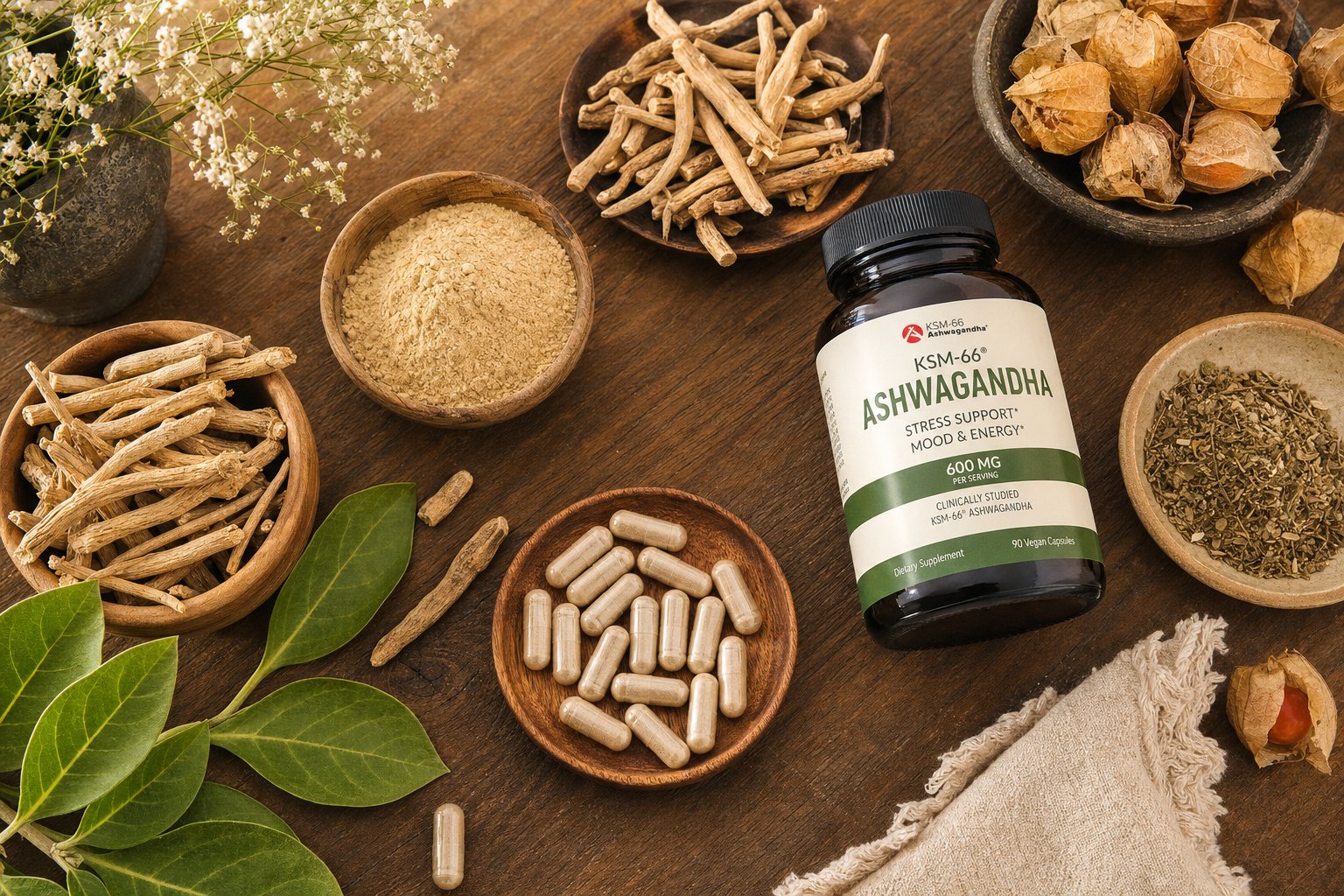
Most clinical research uses standardised root extracts — KSM-66 and Sensoril are the most studied forms — at doses typically between 240mg and 600mg per day over 8–12 weeks. Results can vary if a product uses a different extract type, concentration, or dosing schedule than what was studied.
Stress and Cortisol: The Strongest Evidence
This is where ashwagandha’s evidence is clearest. Multiple randomised controlled trials and several meta-analyses have found significant reductions in perceived stress and cortisol levels compared to placebo — typically over 8–12 weeks of consistent use.
A 2025 meta-analysis found significant cortisol reduction even in trials where perceived stress scores didn’t always improve — which suggests the physiological effect is real even when self-reported stress measures are variable. The direction of evidence is consistently positive here, and the effect sizes are meaningful rather than trivial.
This doesn’t mean ashwagandha eliminates stress or replaces addressing its root causes. What it appears to do is modulate the physiological stress response — lowering baseline cortisol, reducing the amplitude of stress reactions, and improving recovery. For people in genuinely high-stress periods, this can translate to feeling meaningfully calmer and more resilient.
Sleep: Reasonable Evidence, Especially for Poor Sleepers
Several clinical trials have found that ashwagandha improves sleep quality, sleep efficiency, total sleep time, and time to fall asleep — particularly in people with insomnia or self-reported poor sleep. The effect appears more consistent in people who are actually struggling with sleep than in good sleepers, which makes biological sense.
The mechanism is likely partly through cortisol reduction (lower evening cortisol supports better sleep onset) and partly through direct GABA-like activity of withanolides. A 2021 RCT with 600mg/day found significant improvements in sleep quality, sleep efficiency, and morning alertness after 8 weeks. These results have been broadly replicated.
For sleep, ashwagandha works best as part of a broader approach — it’s not a substitute for good sleep habits, but it can complement them meaningfully. See our guide on falling asleep faster for the full behavioural toolkit.
Anxiety: Promising But Not a Treatment
Recent meta-analyses report reductions in anxiety scores versus placebo, with several trials showing improvements on validated anxiety scales including the Hamilton Anxiety Rating Scale. The evidence is real but heterogeneous — different products, doses, and populations produce variable results, and study quality is often moderate rather than high.
A 2026 review concluded that ashwagandha “should not yet be regarded as a definitive treatment option” for anxiety disorders, characterising it as a promising complementary strategy. This is the right framing. If you have clinically significant anxiety, ashwagandha is not a substitute for evidence-based treatments like CBT or, where appropriate, medication. As a complementary support for subclinical stress and anxiety in generally healthy people, the evidence is more favourable.
Testosterone and Male Fertility: Limited But Real Signal
Several studies have found modest increases in testosterone in men, primarily in contexts of chronic stress, infertility investigation, or resistance training. The effect isn’t dramatic — we’re not talking about the kind of testosterone increase that transforms body composition — but it appears real in specific populations. The mechanism is probably partly through cortisol reduction (high cortisol suppresses testosterone) rather than a direct androgenic effect.
Evidence in women for testosterone effects is weak or absent. The fertility-related findings — improved sperm count, motility, and antioxidant status — are more consistent in the male fertility literature than the testosterone data alone.
Physical Performance: Mixed Results
Some trials have found improvements in strength, VO2 max, and recovery with ashwagandha supplementation alongside training. The effect sizes tend to be modest and results are inconsistent across studies. It’s probably not a meaningful performance enhancer for serious athletes, but it may support recovery and adaptation in regular exercisers, particularly through the stress-cortisol pathway.
Dose, Timing, and Which Form to Choose
Most research uses 300–600mg of standardised root extract daily. KSM-66 (full-spectrum root extract, 5% withanolides) and Sensoril (root and leaf extract, higher withanolide concentration at 10%) are the best-studied forms. Generic “ashwagandha powder” without standardisation is less predictable in effect.
Timing: ashwagandha can be taken in the morning or evening. For sleep benefits specifically, evening dosing makes more intuitive sense. For stress and cortisol, morning dosing is commonly used. Some people split the dose.
Effects typically take 4–8 weeks to become noticeable. This isn’t a supplement you feel acutely — the benefits accumulate gradually over consistent use.
Who Should Be Cautious
Ashwagandha is generally well-tolerated at recommended doses, but a few groups need to be careful:
- Pregnant women — ashwagandha has historically been used to induce abortion in traditional medicine. It should be avoided during pregnancy.
- People with thyroid conditions — ashwagandha may increase thyroid hormone levels, which could be a problem for people with hyperthyroidism or those on thyroid medication.
- People on sedatives or benzodiazepines — the GABA-like activity could compound sedative effects.
- People with autoimmune conditions — immunomodulatory effects could potentially aggravate certain autoimmune diseases.
Rare cases of liver injury associated with ashwagandha have been reported — the risk appears very low at standard doses from reputable products, but it’s worth choosing established brands and not exceeding recommended doses.
Frequently Asked Questions
What does ashwagandha actually do?
Its strongest effects are reducing perceived stress and physiological cortisol response. It also improves sleep quality, particularly in poor sleepers, and has a modest signal for reducing anxiety. Testosterone and performance benefits are real but smaller than often marketed.
How long does ashwagandha take to work?
Most people notice effects after 4–8 weeks of consistent daily use. Acute effects on the day of taking it are generally not noticeable — this is a supplement that works through gradual adaptation of the stress response system.
What is the best dose of ashwagandha?
300–600mg of standardised root extract daily is the range used in most clinical trials. KSM-66 at 600mg/day is the most studied protocol for stress and sleep benefits.
Can ashwagandha help with anxiety?
It can reduce anxiety scores in trials, but it’s not a treatment for clinical anxiety disorders. It’s better characterised as a complement to other approaches for subclinical stress and anxiety in generally healthy people.
Is ashwagandha safe for women?
Generally yes for non-pregnant women, though evidence is more limited than for men. Pregnant women should avoid it. Women with thyroid conditions should consult a doctor before use.
The Bottom Line
Ashwagandha is one of the better-evidenced supplements in the adaptogen category. The stress and cortisol evidence is solid. The sleep evidence is good, particularly for poor sleepers. The anxiety evidence is promising but not conclusive. Everything else — testosterone, performance, fertility — has a real signal but smaller and more variable effect sizes than the marketing suggests.
If you’re in a genuinely high-stress period, sleeping poorly, or looking for a complementary support for anxiety alongside behavioural approaches, ashwagandha at 300–600mg of a standardised extract is a reasonable choice. If you’re hoping it will transform your testosterone, dramatically change your body composition, or cure anxiety, the evidence doesn’t support those expectations.
Related: Best Supplements for Overall Health | How to Fall Asleep Faster | Stress and Aging
Related: Hydration and Longevity: How Water Shapes Energy, Skin, and Aging

 Sarah Mitchell
 Dr. Rachel Stone
 James Holloway